
metre per second squared
SI coherent derived unit
| Name | Symbol | Quantity | Base units |
| metre per second squared | m s−2 | acceleration | m s−2 |
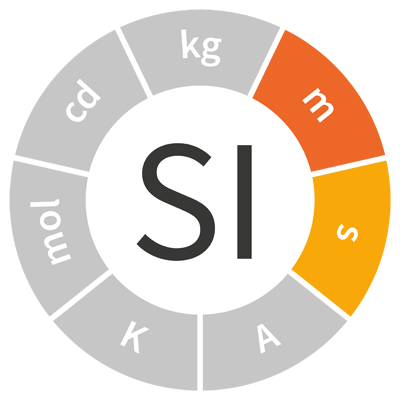 The metre per second squared, symbol m s−2, is the SI coherent derived unit of acceleration. The metre per second squared, symbol m s−2, is the SI coherent derived unit of acceleration.
An object with a constant acceleration of one metre per second squared experiences an increase in velocity of one metre per second over a period of one second. |
|||
| Definition | c ΔνCs | ||
 |
 |
||
Acceleration is a vector quantity, it has magnitude and direction.
Physics
Acceleration is the rate of change of velocity of an object with respect to time. An object’s acceleration is the net result of all forces acting on the object. Newton’s Second Law states that force is proportional to mass multiplied by acceleration.

where:
- F is the net force applied in newtons, symbol N,
- m is the mass of the object in kilograms, symbol kg,
- a is the object’s acceleration measured in metres per second squared, symbol m s-2.
One newton is equal to one kilogram metre per second squared. Therefore, the unit metre per second squared is equivalent to newton per kilogram, N kg−1, or N/kg.
The Earth’s gravitational field at sea level is approximately 9.8 m s−2, or 9.8 N/kg.
 Metric System