
becquerel
SI coherent derived unit with special name and symbol
| Name | Symbol | Quantity | Base units |
| becquerel | Bq | activity referred to a radionuclide | s-1 |
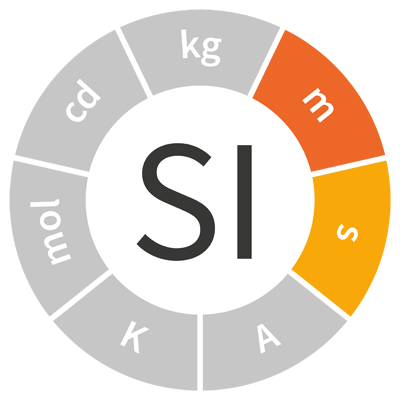
 The becquerel, symbol Bq, is the SI coherent derived unit of radioactivity. It is the special name for the reciprocal second, symbol s-1. The becquerel, symbol Bq, is the SI coherent derived unit of radioactivity. It is the special name for the reciprocal second, symbol s-1.One becquerel is the activity of a quantity of radioactive material in which one atomic nucleus decays per second. |
|||
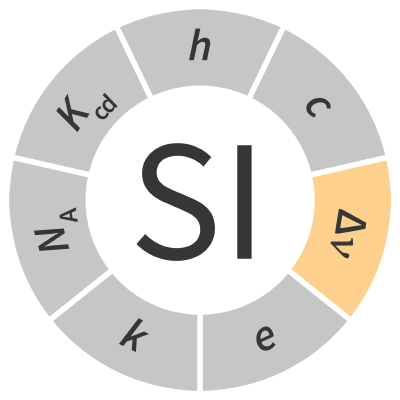
| Definition | ΔνCs | ||
 |
 |
||
The becquerel is named after the French physicist Henri Becquerel (1852 – 1908).
When expressed in SI base units, the unit for radioactivity is the reciprocal second, symbol s−1. If the reciprocal second is used with prefixes, there is a potential for values to be misinterpreted. For example 1 µs−1 might be taken to mean 1 × (10−6 s)−1, or 106 nuclear decays per second.
To avoid any potential for confusion when using prefixes with the unit, and to distinguish the aperiodic nature of the phenomenon of radioactivity, the special name for the unit, becquerel, symbol Bq, is used.
The hertz is not used for radioactivity as its use is reserved for periodic phenomena. One hertz is equal to one periodic cycle per second. By their nature, radionuclide events are aperiodic and so cannot be measured in hertz. The becquerel is equal to one aperiodic radionuclide event per second.
Radiation-related units
| becquerel | Bq | activity referred to a radionuclide | |
|
| coulomb per kilogram | C/kg | exposure (x- and γ-rays) |
 |
 |
| gray | Gy | absorbed dose |  |
 |
| sievert | Sv | dose equivalent | |
|
| gray per second | Gy/s | absorbed dose rate |  |
|
 Metric System