

henry per metre
SI coherent derived unit whose name and symbol includes an SI coherent derived unit with a special name and symbol
| Name | Symbol | Quantity | Base units |
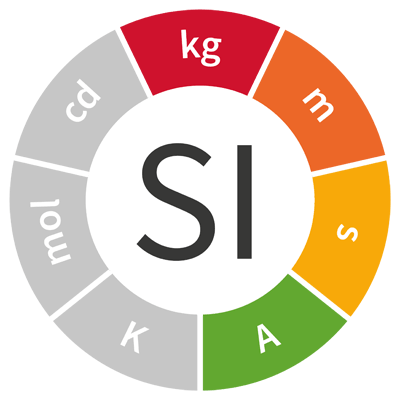
| henry per metre | H/m | permeability | kg m s−2 A−2 |
 The henry per metre, symbol H/m, is the SI coherent derived unit of magnetic permeability. The henry per metre, symbol H/m, is the SI coherent derived unit of magnetic permeability.One henry per metre is equal to the magnetic permeability of a material that produces a magnetic flux density of one tesla, or one weber per square metre, when a magnetic field of one ampere per square metre is applied to it. |
|||
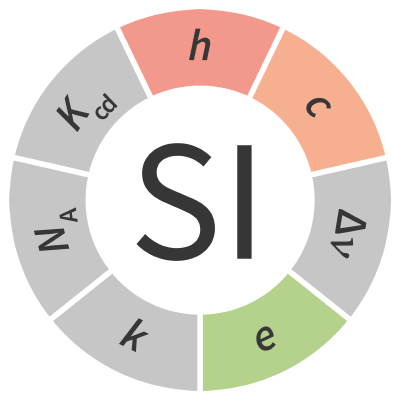
| Definition | h c-1 e-2 | ||
 |
 |
||
Permeability
In electromagnetism, permeability is a measure of the amount of magnetisation that is produced in a material in response to an applied magnetic field.
When a magnetic field is applied to a material, the resulting magnetic flux density, B, is directly proportional to the strength of the applied magnetic field, H, and the magnetic permeability, μ, of the material.
Using SI coherent units,

where:
- B is the magnetic flux density in teslas, symbol T, (or webers per square metre, symbol Wb m-2),
- H is the strength of the applied magnetic field in amperes per metre, symbol A m-1,
- μ is the magnetic permeability in henries per metre, symbol H m-1.
Magnetic permeability, μ, is analogous to electric permittivity, ε.
Magnetic constant
The magnetic constant, μ0, also known as the permeability of free space, or vacuum permeability, is the value of the magnetic permeability of vacuum.
Prior to 2019, the ampere was defined as, “that constant current which, if maintained in two straight parallel conductors of infinite length, of negligible circular cross-section, and placed 1 metre apart in vacuum, would produce between these conductors a force equal to 2 × 10⁻⁷ newton per metre of length.”
This had the effect of defining the value of the magnetic constant, μ0, to be exactly equal to 4π × 10−7 H m-1.
As a consequence of the 2019 redefinition of the ampere, the magnetic constant is no longer defined with an exact numeric value. Its definitive value now depends on the measured value of the fine-structure constant. However, its approximate value can still be calculated as follows:

Fine-structure constant
The fine-structure constant is a fundamental physical constant which quantifies the strength of the electromagnetic interaction between elementary charged particles. The fine-structure constant, α, is dimensionless and can be defined in terms of the electric constant or the magnetic constant as follows:
Using SI coherent units,

where:
- ε0 is the electric constant in farads per metre, symbol F m-1,
- μ0 is the magnetic constant in henries per metre, symbol H m-1,
- h is the Planck constant in joule seconds, symbol J s,
- c is the speed of light in vacuum in metres per second, symbol m s-1,
- e is the elementary charge in coulombs, symbol C.
It follows that the magnetic constant, μ0, can be defined in terms of the fine-structure constant, α:

In the SI, h, c and e are all defined with exact numeric values, which means that the value of the magnetic constant, μ0, depends on only one measured value – the fine-structure constant, α. The measured numerical value of α is 0.007 297 352 569 3(11).
Thus the value of the magnetic constant, μ0, can be calculated as follows:

 Metric System