

joule per kilogram kelvin
SI coherent derived unit whose name and symbol includes an SI coherent derived unit with a special name and symbol
| Name | Symbol | Quantity | Base units |
| joule per kilogram kelvin | J/(kg K) | specific heat capacity, specific entropy |
m2 s−2 K−1 |
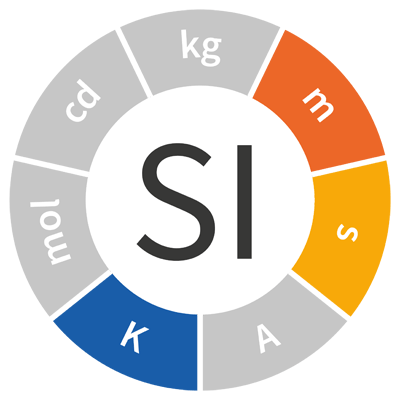 The joule per kilogram kelvin, symbol J/(kg K) or J kg-1 K−1, is the SI coherent derived unit of specific heat capacity, and specific entropy. The joule per kilogram kelvin, symbol J/(kg K) or J kg-1 K−1, is the SI coherent derived unit of specific heat capacity, and specific entropy.One joule per kilogram kelvin is equal to the specific heat capacity of a substance that requires one joule of heat energy to raise the temperature of one kilogram of the substance by one kelvin. |
|||
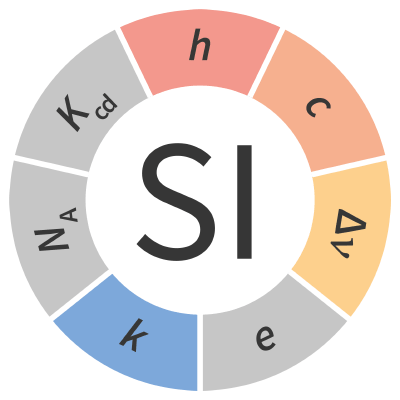
| Definition | h−1 c2 ΔνCs−1 k | ||
 |
 |
||
Specific heat capacity
The amount of heat energy needed to raise the temperature of an object by one kelvin depends on the object’s substance. The amount of energy needed is also directly proportional to the mass of the object.
To be able to make meaningful comparisons of the heat capacity of different substances, it is useful to measure the heat energy needed to raise the temperature of a unit mass of each substance. In the SI, the unit of mass is the kilogram.
The amount of heat energy needed to raise the temperature of one kilogram of a substance by one kelvin is equal to the specific heat capacity of the substance.
Examples of specific heat capacity
| Substance | Specific heat capacity at 298 K (25 °C) / J kg-1 K−1 |
Liquids |
|
| Water | 4181 |
| Methanol | 2140 |
| Ethanol | 2440 |
| Mercury | 139 |
Solids |
|
| Water (ice) at -10 °C | 2050 |
| Aluminium | 897 |
| Graphite | 790 |
| Tin | 227 |
Gases |
|
| Water (steam) at 100 °C | 2080 |
| Helium | 5193 |
| Nitrogen | 1040 |
| Oxygen | 918 |
 Metric System