
astronomical unit
Non-SI unit accepted for use with the SI
| Name | Symbol | Quantity | SI units | |
| astronomical unit | au | length | 149 597 870 700 m | |
 The astronomical unit, symbol au, is a non-SI unit of length accepted for use with the SI. The astronomical unit, symbol au, is a non-SI unit of length accepted for use with the SI.One astronomical unit is equal to 149 597 870 700 m, or approximately 150 gigametres. |
||||
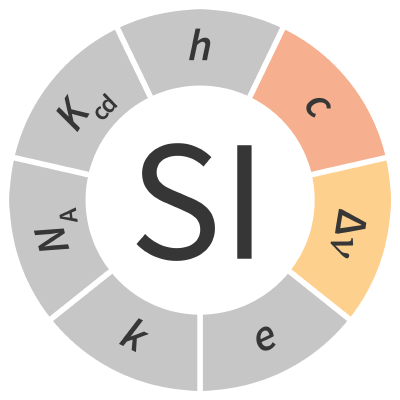
| Definition | c ΔνCs-1 | |||
 |
 |
|||
Astronomy
The astronomical unit is approximately equal to the average distance from the Earth to the Sun. It is used primarily in the field of astronomy for measuring distances within the Solar System, or interplanetary distances around other stars.
Examples of distances of planets from the Sun
| Name | Distance in au | Distance in SI units |
| Mercury | 0.387 | 58 Gm |
| Venus | 0.723 | 108 Gm |
| Earth | 1 | 150 Gm |
| Mars | 1.52 | 228 Gm |
| Jupiter | 5.20 | 778 Gm |
| Saturn | 9.54 | 1427 Gm |
| Uranus | 19.2 | 2871 Gm |
| Neptune | 30.1 | 4495 Gm |
Parsec
The astronomical unit and the arc second, both of which are non-SI units accepted for use with the SI, together form the definition of the parsec – another non-SI unit of length used in the field of astronomy.
 Metric System